Skip to main content
Voyeurism Lawyers in Toronto
Understanding Voyeurism Charges in Canada
 Parliament added voyeurism as an offence to the Criminal Code of Canada in 2005 to address how new technologies can enable secret sexualized observation and recording. A conviction can severely impact your reputation, employment, and personal life and may place you on Canada's Sexual Offender Registry for at least a decade—and in some cases for life.
If you face voyeurism charges in Toronto, Brampton, Newmarket, Oshawa, Milton, or elsewhere in Ontario, contact Daniel Brown Law for a confidential consultation with a criminal defence lawyer.
Why Choose Daniel Brown Law for a Voyeurism Defence?
Our firm is repeatedly recognized as one of the country's best criminal defence law firms—named among Canada's Top Criminal Law Boutiques by Canadian Lawyer Magazine, and ranked by Best Lawyers among the nation's leading criminal defence and appellate law firms.
We are one of only a handful of Canadian criminal defence firms honoured by The Globe and Mail as one of Canada's Best Law Firms for 2026, and we are frequent winners in the Toronto Star Readers' Choice Awards for Best Law Firm and Best Legal Services.
Daniel Brown, Lead Counsel at Daniel Brown Law, is a recognized expert in defending voyeurism charges. His widely cited textbook, Prosecuting and Defending Sexual Offence Cases, addresses voyeurism and other sexual offences and is relied upon by judges, prosecutors, and defence lawyers across Canada. Learn more about Daniel's text.
Designated as a certified criminal law specialist, Daniel has successfully defended clients in voyeurism cases across Ontario.
Frequently Asked Questions About Voyeurism
What Is Voyeurism?
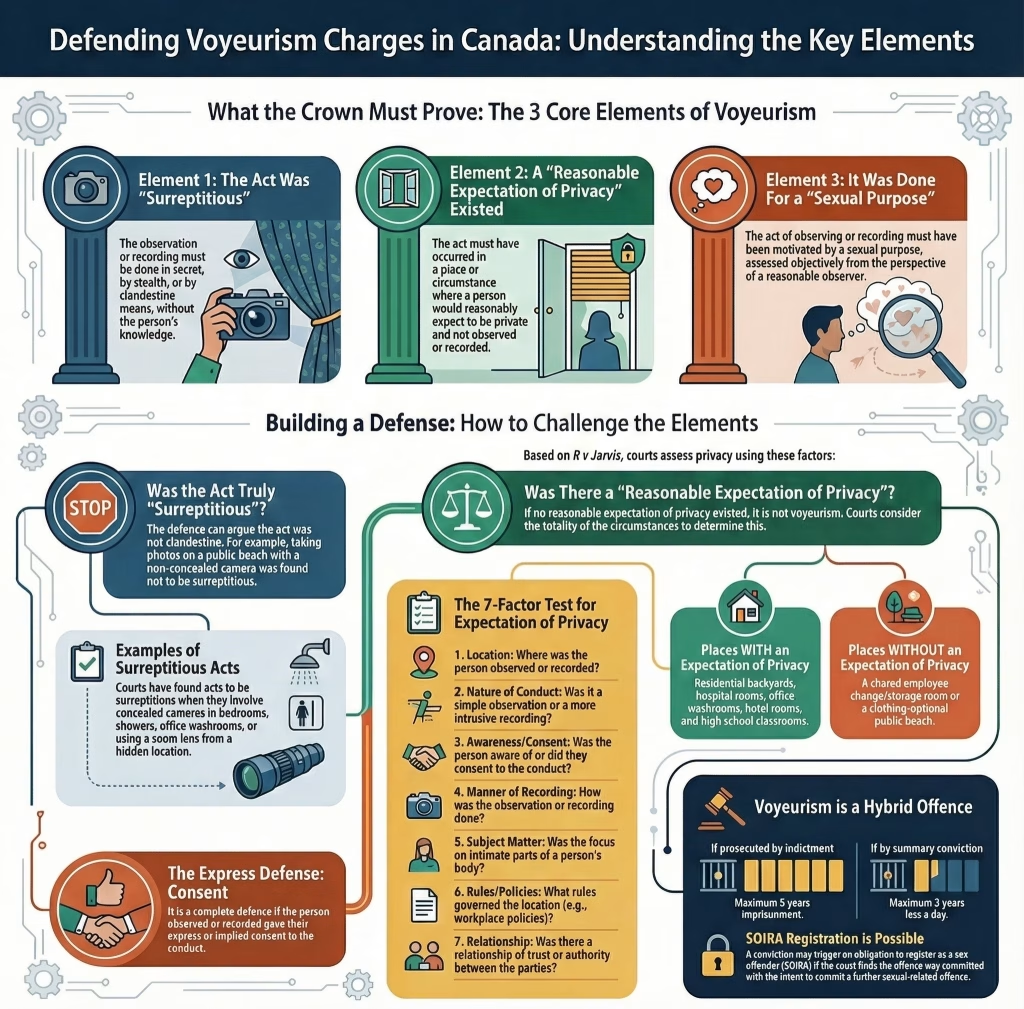
The legal definition of voyeurism under section 162(1) of the Criminal Code is precise and goes far beyond the common understanding of the term. Voyeurism is defined as secretly observing or recording a person in circumstances where they have a reasonable expectation of privacy. For a conviction, the Crown prosecutor must prove three core components beyond a reasonable doubt.
1) Secret Observation or Recording
The act must be "surreptitious," which the courts have interpreted using its ordinary dictionary meaning. This means the Crown must prove the observation or recording was done secretly, without the other person's knowledge.
2) A Reasonable Expectation of Privacy
The person being observed must have been in a situation or place where they had a reasonable expectation of privacy. This is a critical element that depends heavily on the specific facts of the case.
3) The Circumstances of the Observation
Finally, the Crown must prove the observation or recording met one of three specific conditions:
- It was done for a sexual purpose.
- The person being observed was nude, exposing their genitals or breasts, or engaged in sexual activity.
- The person was in a place where they could reasonably be expected to be in a state of undress, such as a bedroom or shower stall.
It is also an offence to print, copy, publish, distribute, circulate, sell, advertise, or make available voyeuristic recordings when you know they were obtained illegally. "Recording" includes photographs, film, or video captured by any means.
For related information, see our page on sexual assault defence.
What Is Meant by a Secret Recording?
Courts interpret "secret" or "surreptitious" by its ordinary meaning. Examples include:
- A camera concealed in a stepdaughter's bedroom
- A hidden camera in a hotel shaving bag recording a 13-year-old girl showering
- A video device placed in an office washroom wastebasket aimed at the toilet
- A co-worker secretly photographing another at an office urinal
- A person in a parked car using a zoom lens to record a child being changed
In contrast, a judge has found that openly taking photos at a nude beach with an ordinary camera did not amount to surreptitious recording; the accused was acquitted in that case.
What Locations Create a Reasonable Expectation of Privacy?
Whether a person had a "reasonable expectation of privacy" is often the central issue in a voyeurism defence. This is not a simple question; it is a legal determination based on the totality of the circumstances.
Courts consider several key factors when making this assessment, including:
- The Location: A person's expectation of privacy is much higher in a private space like a bedroom or bathroom compared to a public location like a beach.
- The Use of Technology: The use of technology to enhance an observation (e.g., a hidden camera or telephoto lens) can create a privacy violation even in a seemingly public space.
- The Person's Attributes: The personal characteristics of the individual being observed, including their age, are relevant to the analysis.
Importantly, the law recognizes that a person can be in a place where they can be reasonably expected to be undressed, such as a changing room. In such a location, the legal requirement for a reasonable expectation of privacy can be met, even if the person was not actually undressed at the specific moment of observation.
Examples of locations where a reasonable expectation of privacy has been found include:
- A men's urinal while in use at the workplace
- The bathroom of a private home
- A women's shower area in a gym or pool facility
- An office washroom with a hidden camera positioned to capture private use
However, courts have ruled that locations such as nude-optional public beaches, high-school classrooms, or shared change rooms may not attract a reasonable expectation of privacy in certain circumstances.
Your Intent (and Their Perception) Both Matter
A voyeurism charge involves two distinct mental elements, known in law as mens rea. Both must be proven by the Crown.
The Intent to Observe in Secret
To secure a conviction, the Crown must prove the observation was deliberately concealed. It is not enough to prove the observation was merely intentional; the Crown must prove you specifically intended for it to be secret.
The Purpose of the Observation
When the "sexual purpose" of the observation is a key element of the charge, the court applies an objective test. The question is not what was subjectively in your mind at the time, but rather how a "reasonable observer" would perceive the act. A court will look at the recording or observation in its full context and ask whether it would be reasonably perceived as being for the purpose of sexual stimulation. This objective standard is a challenging legal hurdle and a critical area where an expert defence is essential.
What Defences Are Available to Voyeurism?
Several defences may apply:
- Public good: The observation served the public interest and did not extend beyond what was necessary.
- No surreptitious recording: The recording was not made secretly.
- No expectation of privacy: The complainant was in a location where privacy could not reasonably be expected.
- No sexual purpose: The content or context did not involve exposure of sexual organs or sexual activity and was not for sexual gratification.
Every case is fact-specific. An experienced Toronto criminal lawyer must review the evidence to build the best defence.
What Is the Sentence for Voyeurism?
A conviction for voyeurism carries severe and long-lasting penalties that can impact every area of your life.
Voyeurism is a "hybrid offence," which means the Crown can choose how to proceed. If they proceed by summary conviction, the maximum penalty is imprisonment for two years less one day. If they proceed by indictment, the maximum penalty is five years in prison.
There is no mandatory minimum sentence for voyeurism. Courts consider the seriousness of the offence, prior criminal record, and aggravating factors such as breaches of trust or use of hidden technology when arriving at a fit sentence.
Will a Person Convicted of Voyeurism Be Placed on the Sexual Offender Registry?
Yes. A voyeurism conviction triggers a hearing for inclusion on Canada's Sexual Offender Registry:
- Summary conviction: At least 10 years on the registry
- Indictable conviction: At least 20 years on the registry
- Multiple convictions: Lifetime registration
Learn more about Canada's Sexual Offender Registry.
Technology and Voyeurism
Smartphones, miniaturized cameras, and drones have increased voyeurism allegations. Courts treat recordings captured by new technology with the same seriousness as traditional surreptitious methods.
Collateral Consequences of a Conviction
Beyond imprisonment and registry placement, a conviction can impact:
- Employment opportunities
- Immigration status and admissibility
- International travel, particularly to the U.S.
- Personal and family relationships
Overlapping Offences
Voyeurism charges often appear alongside other allegations such as mischief, criminal harassment, or child pornography offences. Skilled defence requires addressing all charges together.
Charter Rights and Voyeurism Investigations
Police often seize electronic devices during voyeurism investigations. Defence counsel may challenge unlawful searches or seizures under the Canadian Charter of Rights and Freedoms, potentially excluding evidence.
What You Do Next Is Crucial for Your Defence
A voyeurism charge is serious, but it is also defensible. The initial steps you take after being arrested or learning of an investigation are absolutely critical to the outcome of your case.
Your Right to Remain Silent
You have the right to remain silent, and you must exercise it. Any communication you have with police while in custody—from a formal interview to casual small talk—can be considered a statement and used against you at trial. Politely but firmly asserting your right to silence is the single most important thing you can do to protect yourself.
Preserving Evidence
Your instinct may be to delete all past contact with the complainant, but this is a mistake. It is vital that you preserve all potential evidence, including voicemails, text messages, emails, and social media conversations. This digital evidence can be critical for building your defence and demonstrating the full context of the situation.
Defending a voyeurism charge demands deep knowledge of the law. Daniel Brown is a Certified Specialist in Criminal Law and the co-author of Prosecuting and Defending Sexual Offence Cases, the leading textbook used by judges, Crown prosecutors, and defence lawyers across Canada. That expertise directly informs every voyeurism defence the firm handles.
Your Voyeurism Defence Starts Now
A voyeurism charge is legally complex and carries life-altering consequences. An effective defence depends on the legal strategy set from the outset.
If you are facing a voyeurism charge, the time to act is now. Contact Daniel Brown Law for a confidential consultation.
Contact Daniel Brown Law
Every voyeurism allegation turns on its own facts and demands an early, informed defence.
Speak with an experienced Toronto voyeurism lawyer today. Call (416) 297-7200.