SCC Upholds Bill C51’s Sexual Offence Regime as Constitutional
 Thursday morning, the Supreme Court of Canada released its much-anticipated decision regarding the constitutionality of the Bill C-51 Amendments. In R v. J.J. ,the majority decision upheld the amendments as constitutional in their entirety, while at the same time offering some clarity on how to interpret them. The Supreme Court’s decision stands to impact thousands of sexual offence cases currently in the system. Below are some of the main takeaways.
The Definition of “Record”
The trial judge must review “both the content and context” of a possible defence record to determine whether it engages a reasonable expectation of privacy such that the s. 278.92 is engaged. The first step is looking at the content of the evidence. No category of evidence is excluded, meaning electronic communications between the complainant and the accused are captured. At para. 49: “Records do not attract a reasonable expectation of privacy simply because of the medium used to convey them. The more important consideration is the sensitivity of the information contained in the record.”
The trial judge must make a determination about whether something is a “record” at stage 1 of the application process under s. 278.93. Because the possible value of impeachment material is often unclear until mid-trial, this means that trial judges will increasingly be tasked with screening potentially irrelevant evidence ahead of time.
However, an argument may be available that what constitutes a “record” should be narrowly construed. At para. 53, the Court states: “the scheme is not intended to catch more mundane information, even if such information is communicated privately. Moreover, given the accused’s right to make full answer and defence, mere discomfort associated with lesser intrusions of privacy will generally be tolerated. In this context, a complainant’s privacy in open court “will be at serious risk only where the sensitivity of the information strikes at the subject’s more intimate self”. Similarly, at para. 54: “a non-enumerated record will fall within the definition of s. 278.1 if it contains information of an intimate and highly personal nature that is integral to the complainant’s overall physical, psychological or emotional well-being.” Finally, at para. 56: “mundane information such as general emotional states, everyday occurrences or general biographical information would typically not give rise to a reasonable expectation of privacy.”
The Supreme Court emphasized that, like for s. 276 evidence, the narrow category to which the record regime applies is part of the gateway to its constitutionality. At para. 162, the Court concludes that “screening in the context of private record applications applies to a narrow set of evidence that implicates important interests of complainants in sexual offence cases and has the potential to create serious prejudice. Private records are analogous to s. 276 evidence, as they can also implicate myths that are insidious and inimical to the truth-seeking function of the trial”.
The Supreme Court was clear that courts must also consider the context in which the record was shared – for example, why the complainant shared the information, and who she shared the information with. Consider, for example, where information was shared with someone with whom the complainant was in a relationship of trust or authority, and whether the information was intended to be shared privately or publicly disseminated. At para. 60: “Records produced in the private domain (e.g., one-on-one communications between the complainant and accused) may attract an enhanced reasonable expectation of privacy; records created or obtained in the public domain, where they could be accessed by multiple people or the general public (e.g., social media or news media), are less likely to attract a reasonable expectation of privacy.”
Note that material may engage the s. 278.92 records regime even if the complainant is not a participant in it. In other words, something might be a record where the evidence is about the complainant. Para. 63: “The complainant may be the sender or recipient of the communication, or the content of the communication pertains to the complainant.”
Finally, note that unlike for s. 276 evidence, even evidence that captures the subject matter of an offence will likely engage the records regime. See paras. 65-67, which highlights that explicit communications, videos, or photographs implicating the subject matter of the charge are “likely” to require a records application.
A “Records” Application is Required When “Adducing” Information
The Supreme Court has clarified that a s. 278.92 records application will be required even where the defence seeks to ask questions about the content of a record, but not adduce the record itself as an exhibit or for impeachment purposes. The situation remains unclear when an accused was formerly in possession of a record but no longer has it – e.g. deleted text messages or emails. At para. 76, the Court states: “Specifically, under the record screening regime, the accused must screen records when they seek to use information during a hearing that they specifically learned from those records. If they have independent knowledge of the information, gathered from sources that do not rely on the complainant’s private records, they may use this information without invoking the record screening regime (subject to other applicable evidentiary rules and trial procedures).” We anticipate this will be the subject of further litigation.
Complainant’s Participatory Rights at Stage 1 and Stage 2
The Supreme Court confirmed that a complainant has no right to participate in a stage 1 hearing under s. 278.93. However, at para. 92, the Supreme Court suggests that the Crown should provide “a general description of the nature of the record and of its relevance to an issue at trial to the complainant and/or the complainant’s counsel…At the same time, only a general description is required at this stage because it is not yet clear whether a Stage Two hearing involving the complainant will be required.” In other words, although the complainant cannot appear and make submissions at a stage 1 hearing, the Crown is permitted to share information with them about the details of the application at this stage.
The Court confirmed that the defence application record should typically be disclosed to the complainant before a stage 2 hearing under s. 278.94 to allow them to meaningfully participate in the process. Note, however, that the trial judge retains a residual discretion to order that an application record not be provided directly to the complainant. At para. 96, the Court states: “Importantly, the presiding judge retains the discretion to direct that the application not be disclosed to the complainant or that portions of it be redacted. This may arise based on a party’s or the judge’s own concerns about the impact of disclosure on trial fairness.” Finally, the Court suggested that the application record should not be provided to the complainant in a confidential way. At paras. 173-175, the Court suggests that the Crown should be involved with the process of disclosing an application record to the complainant and consulting with them about it. As always, should anything arise as a result of that consultation, that evidence must be disclosed to the defence.
Finally, the Supreme Court confirmed that complainant counsel has no right to cross-examine an accused on an affidavit filed at stage 2 of the application hearing, and that this ability is reserved for the Crown only.
Record Applications Should be Brought Pre-Trial
The Supreme Court held that mid-trial records applications should be the exception, not the rule. However, the court leaves open the possibility of bringing an application during cross-examination where advanced disclosure “will genuinely negate the efficacy of cross‑examination”: at para. 190. In reaching this conclusion, the Court was concerned about trial efficiency. At para. 86, it states: “However, as a general rule, private record applications should be brought at the pre-trial stage of the proceedings. There is good reason for this. If mid-trial applications become routine, this would result in frequent adjournments, significant delays, scheduling difficulties – particularly in jury trials – and potential unfairness to the accused. Mid‑trial applications could also harm complainants and discourage the reporting and prosecution of sexual offences.”
Final Notable Issues
A few subsidiary points are worth noting. First, at para. 73, the Supreme Court held that the Crown is not bound by the records regime. In other words, the Crown has no obligation to bring a records application, unlike where the Crown intends to lead evidence of the complainant’s other sexual activity and is required to bring a common law Seaboyer application.
Second, the Supreme Court commented on the motion for directions procedure that has been widely used to date for litigating whether evidence engages the record regime. The Court stated that motions for direction should be rare but may be appropriate in certain circumstances. At para. 103, the Court states that “they are purely a discretionary exercise of the presiding judge’s trial management power.” Note that, at para. 105, the Court commented that the trial judge retains discretion to give a complainant standing at this type of motion.
Finally, as a procedural point, the Supreme Court confirms that complainant appeals of stage 2 hearings by way of certiorari applications or by way of appeal directly to the Supreme Court (as was done by the complainant A.S. in this case) should be rare. At para. 110, the Court comments that: “interlocutory appeals arising out of s. 276 or private record applications should be rare and restricted to clearly exceptional circumstances.”
Why Choose Daniel Brown Law?
Daniel Brown Law is a leading Canadian criminal defence firm. Daniel Brown is a certified specialist in criminal law — a designation held by fewer than 2% of criminal lawyers in Ontario. He is the author of Prosecuting and Defending Sexual Offence Cases (3rd Edition, Emond Publishing’s Criminal Law Series), has authored articles for legal journals, and contributes commentary on criminal law to The Toronto Star and other major Canadian news outlets.
The firm and its lawyers have been repeatedly recognized for excellence in criminal defence:
- Certified Specialist in Criminal Law — Law Society of Ontario (Daniel Brown — fewer than 2% of Ontario criminal lawyers hold this designation)
- Best Lawyers in Canada — Criminal Defence — Daniel Brown personal listing
- Canada’s Top Criminal Law Boutiques 2026–27 — Canadian Lawyer Magazine
- Best Law Firms 2026 — Criminal Defence and Appellate Practice (Best Lawyers / Best Law Firms)
- Canada’s Best Law Firms 2026 — The Globe and Mail (Report on Business)
- Toronto Star Readers’ Choice Awards — Best Law Firm and Best Legal Services, repeat winner
- Toronto’s Top Criminal Lawyers — Streets of Toronto and Post City Magazine







 Why Uttering Threats Is a Serious Criminal Offence
 Defending Dangerous Driving Charges in Toronto
 In 2026, Daniel was voted the




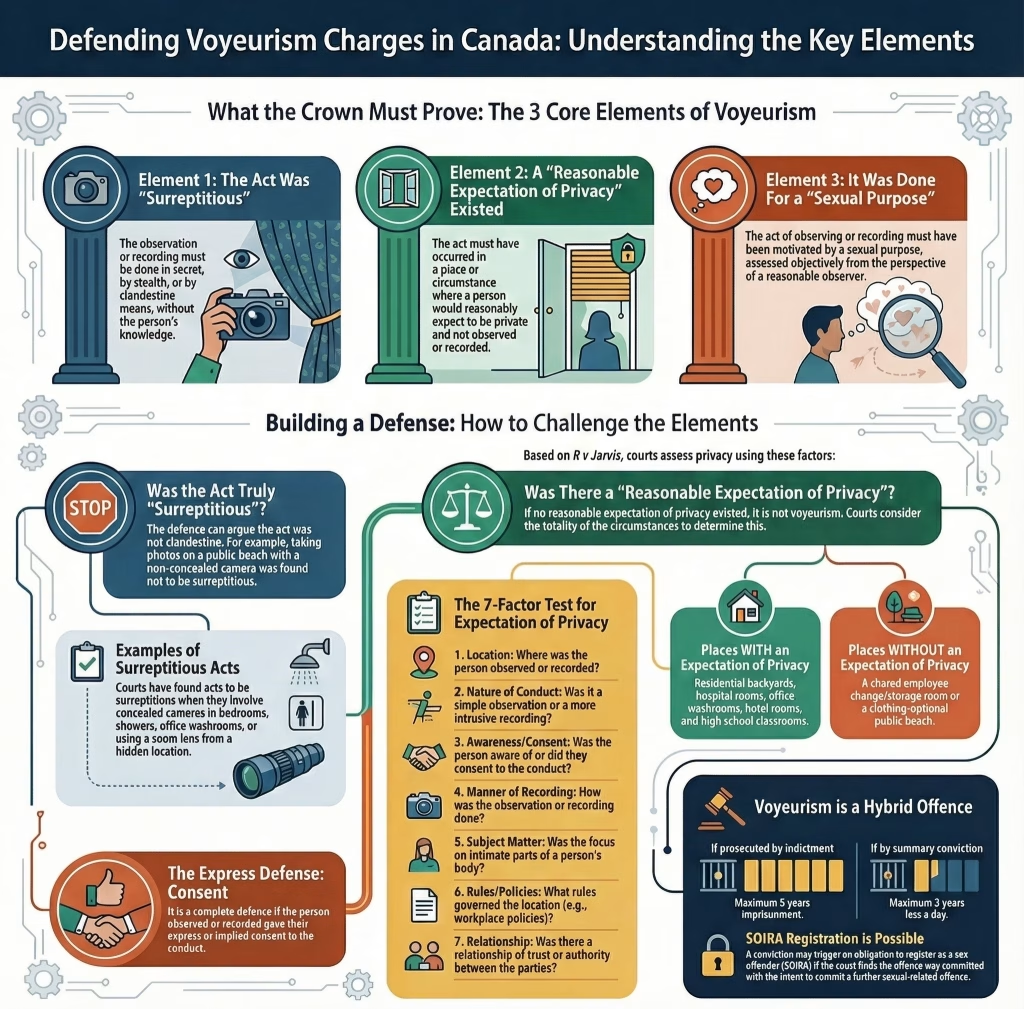
 Parliament added voyeurism as an offence to the Criminal Code of Canada in 2005 to address how new technologies can enable secret sexualized observation and recording. A conviction can severely impact your reputation, employment, and personal life and may place you on Canada's