... Skip to main content
Corporal Punishment in Canada – to spank or not to spank?

Corporal Punishment in Canada – to spank or not to spank?

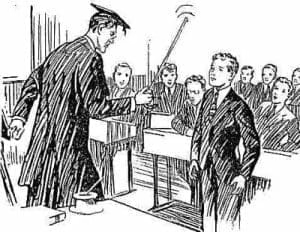
corporal punishmentThis article attempts to clarify to what extent parents or teachers can physically discipline children under their care.

Section 43 of the Criminal Code of Canada, enacted in 1892, provides parents, teachers and caregivers — including babysitters and foster parents — a defence to an assault allegation when they use corporal punishment as “reasonable force” to discipline children.

Section 43 contemplates four elements which must be present if the disciplining is to be justified:

(a) a certain relation between the discipliner and the child;

(b) the force used must be used for the purpose of correction;

(c) the child must be under the care of the discipliner when the force is used; and

(d) the force must not “exceed what is reasonable under the circumstances” (more…)

Changes to the Citizen’s Power of Arrest, Self-Defence and Defence Of Property Laws in Canada

web-policetapeOn June 28th, 2012, Bill C-26 (also known as) the Citizen's Arrest and Self-defence Act, received Royal Assent and came into force on March 11th, 2013.

The bill has expanded on the citizen's arrest powers and reformed the law with respect to the self-defence and defence of property provisions in the Criminal Code of Canada.

Citizen's Arrest:

Looking first at the changes to the citizen’s arrest power, Bill C-26 has amended section 494(2) of the Code by authorizing a private citizen to make an arrest within a reasonable period of time after he or she finds someone committing a criminal offence that occurred on or in relation to their property.

This expanded power of arrest granted in the new law will only be authorized when there are reasonable grounds to believe that it is not feasible in the circumstances for the arrest to be made by a police officer.

Prior to the change in legislation, a private citizen was only permitted to make an arrest if the perpetrator was found committing a criminal offence on or in relation to that private citizen's property.

The amendments to the section now eliminate the requirement that the offender be caught in the criminal act as long as he/she is apprehended within a reasonable time after the offence is committed.

Self Defence and Defence of Property:

Bill C-26 also changes the self-defence provisions of the Criminal Code. Sections 34-37 of the Code have been repealed and replaced by one new self-defence provision. The amendment now permits a person who reasonably believes themselves or others to be at risk of the threat of force, or of acts of force, to commit a reasonable act to protect themselves or others.

Amendments to the defence of property provisions have also repealed sections 38-42 of the Criminal Code in favour of one new defence of property provision. The new provision permits a person in "peaceable possession" of a property to commit a reasonable act (including the use of force) for the purpose of protecting that property from being taken, damaged or trespassed upon.

Prior to these amendments, the self-defence provisions dealt with a person who used force to protect himself or another from assault depending on various aspects of the particular situation, such as whether they provoked the attack or not and whether they intended to use deadly force. The new amendments clarify and streamline our self-defence laws by no longer requiring the accused to pigeonhole his actions into one of the many (and often confusing) self-defence sections in the Criminal Code.

Use of Deadly Force

Despite the significant changes to the law of self-defence and defence of property, Bill C-26 does not make any changes to the law with respect to the use of deadly force as it relates to self-defence or defence of property.

In Canadian law, the use of deadly force is only permitted in very exceptional circumstances – for example, where it is necessary to protect a person from death or grievous bodily harm. Canadian courts have clearly stated that deadly force is not considered reasonable in defence of property alone.

Defending Forcible Confinement Charges in Toronto, Ontario

Defending Forcible Confinement Charges in Toronto, Ontario

Forcible Confinement Lawyers Toronto

How to Defend Forcible Confinement Charges

This article is a brief and general overview about forcible confinement charges in Toronto, Ontario under section 279(2) of the Criminal Code of Canada. Those facing a forcible confinement allegation should consult a criminal lawyer. For those seeking information about related charges, follow these links to domestic assault, sexual assault, and assault.

Daniel Brown Law is named among Canada's Top Criminal Law Boutiques by Canadian Lawyer Magazine, ranked by Best Lawyers among the nation's leading criminal defence and appellate law firms, recognized by The Globe and Mail as one of Canada's Best Law Firms for 2026, and a frequent winner of the Toronto Star Readers' Choice Awards for Best Law Firm and Best Legal Services.

The lawyers at Daniel Brown Law have defended forcible confinement charges in all corners of the province and often appear in courts across the GTA in addition to the Toronto courthouses including Newmarket, Oshawa, Brampton, and Milton.

Frequently asked questions about forcible confinement charges in Toronto, Ontario:

What is forcible confinement?

Forcible confinement is set out in section 279(2) of the Criminal Code. A person commits the offence when, without lawful authority, they confine, imprison, or forcibly seize another person. The confinement does not need to involve a locked room or physical bindings. Any deprivation of a person's liberty, for any significant period, can meet the definition if the accused caused it without legal justification.

What is the difference between forcible confinement and kidnapping?

Kidnapping under section 279(1) of the Criminal Code requires that the accused move the complainant from one place to another against their will. Forcible confinement under section 279(2) requires only that the complainant's movement be restricted at a single location. The practical difference is asportation: kidnapping carries a maximum penalty of life imprisonment because of the movement element, while forcible confinement carries a maximum of ten years on indictment.

How long must a person be confined to face charges?

There is no minimum time requirement in the statute. Courts have convicted accused persons for confinements lasting only a few minutes. What matters is whether the complainant's liberty was meaningfully restricted, not how long the restriction lasted. A brief confinement still qualifies, though the duration becomes relevant later at the sentencing stage.

Does the confinement need to involve physical restraint?

No. Confinement can be achieved through threats, intimidation, or by blocking an exit. If a person reasonably believes they are not free to leave because of something the accused said or did, that is enough. The Crown does not need to prove the accused touched the complainant or used a weapon — only that the complainant was prevented from leaving.

What if the complainant initially agreed to stay and later wanted to leave?

Consent to be in a place can be revoked at any time. Once a complainant makes it clear they want to leave, any conduct by the accused that prevents them from doing so can form the basis of a forcible confinement charge. This often arises during arguments at home, where one person blocks a doorway, takes car keys, or refuses to let the other person out of a vehicle.

Why are forcible confinement charges common in domestic cases?

Forcible confinement is frequently laid alongside assault, sexual assault, uttering threats, or mischief in domestic disputes. A complainant may describe being held in a bedroom, having a phone taken away, or being prevented from leaving during an argument. These allegations are difficult to defend because they usually come down to the word of the complainant against the word of the accused, without independent witnesses or physical evidence. They can also surface for the first time during separation, divorce, or custody proceedings, where a criminal allegation may influence the family law outcome.

What must the Crown prove to secure a conviction?

The Crown must prove each of the following beyond a reasonable doubt:

  • the accused confined, imprisoned, or forcibly seized the complainant;
  • the confinement was without the complainant's consent;
  • the accused had no lawful authority to confine the complainant; and
  • the accused intended to confine the complainant, or knew the conduct would have that effect.

If the Crown fails on any one of these elements, the accused is entitled to an acquittal. A skilled defence lawyer will look at each element in isolation and identify which one is weakest on the evidence.

What defences are available to forcible confinement charges?

Defences depend on the facts of the case. Common defences in forcible confinement cases include:

  • The complainant was not actually confined. If the complainant was free to leave at any time, no offence occurred.
  • Consent. If the complainant chose to stay and later changed their account, that can undermine the Crown's case.
  • Credibility and reliability. Inconsistencies between the complainant's police statement, preliminary inquiry evidence, and trial testimony can create reasonable doubt.
  • Identification. If the complainant has misidentified the accused, the charge cannot succeed.
  • Lawful authority. Parents restraining a child, private citizens effecting a lawful arrest, and certain caregiving situations can give rise to lawful authority.
  • Self-defence or defence of another. In narrow circumstances, restraining another person to prevent harm may be justified.
  • Charter challenges. Unlawful arrest, unreasonable search, or improper questioning may lead to the exclusion of key evidence.

Many forcible confinement cases are resolved before trial through careful Crown negotiation, particularly where the allegation is uncorroborated and the complainant's account shifts over time.

What are the consequences of a forcible confinement conviction?

The Crown may prosecute forcible confinement by indictment (maximum ten years in prison) or by summary conviction (maximum two years less a day). The sentence imposed depends on the circumstances of the offence, whether a weapon was used, whether the complainant is a vulnerable person, the length of the confinement, and the accused's background.

A conviction can also carry long-term consequences beyond the sentence itself, including:

  • a criminal record stored on the national CPIC database;
  • a DNA order;
  • a firearms prohibition;
  • difficulty finding or keeping employment, especially in regulated fields;
  • problems with immigration, permanent residence, and citizenship applications;
  • denial of entry to the United States and other countries;
  • restrictions in family law proceedings, including custody and access; and
  • the risk of the conviction being reported publicly in the media.

Every forcible confinement allegation is a fact-specific inquiry. Speaking with a lawyer early allows you to understand the evidence against you and identify the strongest defence available. Call Daniel Brown Law at (416) 297-7200 for a consultation about your case.

Utter Threats Lawyers Toronto – Defending an Utter Threats Charge

Utter Threats Lawyers Toronto – Defending an Utter Threats Charge

Uttering threats lawyer TorontoWhy Uttering Threats Is a Serious Criminal Offence

In Canada, threatening another person—verbally, in writing, or electronically—can lead to criminal prosecution. Section 264.1 of the Criminal Code makes uttering threats a serious criminal offence, punishable by fines, imprisonment, or both.

Allegations of threatening death or bodily harm often arise from domestic disputes. These cases frequently include additional charges such as assault or mischief. Resolving them means accounting for the parties' circumstances, any ongoing family relationships, and the public interest. For more information on domestic assault cases, read here.

Our Defence Experience

The lawyers at Daniel Brown Law have defended utter threats charges across Ontario. We regularly appear in courthouses throughout the GTA, including Toronto, Brampton, Milton, Newmarket, and Oshawa.

Our firm is repeatedly recognized as one of the country's best criminal defence law firms—named among Canada's Top Criminal Law Boutiques by Canadian Lawyer Magazine, and ranked by Best Lawyers among the nation's leading criminal defence and appellate law firms.

We are one of only a handful of Canadian criminal defence firms honoured by The Globe and Mail as one of Canada's Best Law Firms for 2026, and we are frequent winners in the Toronto Star Readers' Choice Awards for Best Law Firm and Best Legal Services.

Daniel Brown, a certified criminal law specialist, brings extensive experience in defending these allegations. His expertise has made him a go-to legal commentator for Canadian media. Recently, the Toronto Star interviewed Daniel in connection with a high-profile case involving online threats:

  • Toronto Star, Rehtaeh Parsons' father says he received online death threat

Our firm regularly defends clients accused of threatening death or bodily harm.

Why Legal Representation Matters

Uttering threats can result in imprisonment and a permanent criminal record. These outcomes affect employment, travel, and personal reputation. Anyone facing such charges should immediately seek legal advice from an experienced criminal defence lawyer.

Daniel Brown Law reviews the evidence, identifies possible defences, and fights to keep these charges off your record. Call us at (416) 297-7200 to arrange a consultation.

Frequently Asked Questions About Uttering Threats

What Is the Legal Definition of Uttering Threats?

Section 264.1 of the Criminal Code defines uttering threats broadly. A person may be charged if they utter, convey, or cause someone to receive a threat:

  • To cause death or bodily harm to any person
  • To damage property by burning, destroying, or vandalism
  • To kill, poison, or injure an animal belonging to someone else

The law considers an utterance to be any spoken or written statement that conveys a threat. To secure a conviction, the Crown must prove that the accused intended the statement to cause another person to fear for their safety or the safety of others.

Can Indirect Threats Lead to Conviction?

Yes. The accused does not need to communicate the threat directly to the intended victim. The offence is complete if the accused makes the threat to a third party. Courts have ruled that it is irrelevant whether the accused expected the third party to pass along the message or whether the intended victim ever learned about it.

Threats can be made verbally, in writing, or through electronic communication such as email, text, or social media.

What Must the Crown Prove in Court?

To convict someone of uttering threats, the Crown must establish beyond a reasonable doubt that:

  1. A threat was made. The statement—spoken, written, or electronic—conveyed a message that could cause a reasonable person to fear for safety.
  2. The threat was directed to another person. It must target an identifiable individual, even if they were not present when it was made.
  3. The accused intended to cause fear. The Crown must show intent to make the other person afraid. Lack of intent can serve as a defence.
  4. The threat was credible. Courts assess whether a reasonable person in the same situation would have taken the threat seriously.

Does It Matter If the Recipient Didn't Take the Threat Seriously?

No. Courts focus on the intent of the person making the statement. Even if the recipient laughed it off or dismissed the words, the offence is established if the accused meant for the statement to cause fear.

What If the Threat Was Impossible to Carry Out?

Impossibility does not eliminate liability. For example, a statement such as "I'll throw you off the CN Tower" may still qualify as a threat. What matters is whether the words were intended to alarm or intimidate, not whether the accused had the ability to act on them.

What Are the Consequences of a Conviction?

Uttering threats carries severe legal penalties:

  • By indictment: Maximum of five years' imprisonment
  • By summary conviction: Maximum of 24 months' imprisonment

Fines may also accompany jail time. Beyond legal punishment, a conviction results in a criminal record, which can:

  • Limit employment opportunities
  • Restrict international travel
  • Impact personal and professional relationships
  • Create housing difficulties

Even for first-time offenders, the consequences can be devastating.

Possible Defences to Uttering Threats

Experienced defence lawyers examine the facts carefully to identify weaknesses in the Crown's case. Potential defences may include:

  • Lack of intent: Showing the accused did not mean to cause fear
  • Context: Demonstrating that words were spoken in jest, anger, or exaggeration without seriousness
  • Ambiguity: Arguing that the alleged threat was too vague to meet the legal standard
  • Charter violations: Excluding evidence obtained through unlawful police conduct

Our lawyers look for gaps in the Crown's evidence -- missing witnesses, inconsistent statements, or flawed forensic analysis. Because the facts vary so much from case to case, early legal advice matters.

How Daniel Brown Law Defends These Cases

How We Handle Your Case: Our Strategy

  1. Review disclosure and evidence thoroughly, including digital communications
  2. Submit Charter applications to challenge unlawful searches or seizures
  3. Negotiate early with the Crown when possible, aiming for reduced charges or alternative resolutions
  4. Prepare a robust defence, focusing on intent and context, for court if necessary

Related Practice Areas

Since criminal charges frequently overlap, consider these related issues:

  • Domestic Assault: Often connected to uttering threats charges.
  • Mischief: Sometimes combined with threats in domestic situations.
  • Criminal Harassment: Related or overlapping conduct under criminal law.
  • Bail Hearings: We handle bail hearings and detention reviews for all criminal charges.
  • Criminal Appeals: Learn more about how you can appeal your conviction or sentence for uttering threats.

Focus on Long-Term Outcomes

Beyond avoiding jail, we work to protect your record, reputation, and future opportunities. In domestic-related cases, we push for resolutions that keep families intact without sacrificing your defence.

Contact Daniel Brown Law

Every uttering threats allegation involves unique circumstances. You should not face these charges without experienced legal representation.

Call Daniel Brown Law at (416) 297-7200 to schedule a confidential consultation.

Self Defence: a person attacked in the home need not retreat

Self Defence: a person attacked in the home need not retreat

burglary_1014464c_optEarlier this week, the Ontario Court of Appeal released their ruling in R. v. Docherty, 2012 ONCA 784. The central issue in Docherty was whether the trial judge improperly instructed the jury that a person under attack has a duty to retreat from their home in order to assert a legitimate claim of self-defence.

Kenneth Docherty killed Tyson Weber by stabbing him seven times in the neck during an altercation inside the garage attached to Docherty’s home. (more…)

The Family Law Consequences of a Criminal Domestic Violence Conviction

family law caseSadly, domestic disputes are quite common in our society.  Whether the accusations of domestic violence are true or not, the consequences of such allegations can wreak havoc on a family’s dynamics for years to come.

Daniel Brown works closely with a group of trusted family law lawyers to ensure that his clients interests are protected both in the criminal courts as well as the family courts.

In the article below, Toronto family law lawyer, Andrew Feldstein, provides insight into how a criminal charge or conviction for a domestic violence related crime can affect a person’s rights in family court: (more…)

Defending Robbery Charges in Toronto

Robbery Lawyer Toronto

robbery arrestExperienced Robbery Defence Lawyers at Daniel Brown Law

At Daniel Brown Law, our team of criminal defence lawyers focuses exclusively on criminal law. Daniel Brown, a certified specialist in criminal law, has defended numerous robbery allegations before both judges and juries across Ontario.

Our firm is repeatedly recognized as one of the country's best criminal defence law firms—named among Canada's Top Criminal Law Boutiques by Canadian Lawyer Magazine, and ranked by Best Lawyers among the nation's leading criminal defence and appellate law firms.

We are one of only a handful of Canadian criminal defence firms honoured by The Globe and Mail as one of Canada's Best Law Firms for 2026, and we are frequent winners in the Toronto Star Readers' Choice Awards for Best Law Firm and Best Legal Services.

If you are charged with robbery or armed robbery including Toronto, Brampton, Oshawa, Newmarket, Milton, or elsewhere in Ontario, we can provide the immediate and strategic defence required to protect your freedom and future. Call us at (416) 297-7200 for a confidential consultation.


Understanding Robbery Charges in Toronto, Ontario

What Is Robbery?

Section 343 of the Criminal Code of Canada defines robbery as an offence that combines elements of theft and violence. A robbery occurs when a person:

  • Steals from another while using violence or threats of violence toward them or their property;
  • Assaults someone with intent to steal; or
  • Steals from a person while armed with a real or imitation weapon.

Unlike ordinary theft, robbery always involves violence, threats, or weapons. For more about theft, visit our page on Toronto theft lawyer services.

What Level of Violence Is Required?

Courts recognize a broad range of actions as "violence" for robbery. For example:

  • Striking, wounding, or beating the victim during a theft;
  • Holding a person's arms to prevent resistance;
  • Using personal force immediately before or after a theft.

The violence need not cause physical harm, but it must be substantial. On the other hand, a minor technical assault, such as nudging or bumping, may not meet the definition.

A person may also be guilty of robbery if they steal while armed with an offensive weapon or imitation weapon. The weapon does not need to be used or even brandished—mere possession during the theft is sufficient.

What Counts as a Threat of Violence?

Whether words or actions amount to a "threat of violence" depends on the circumstances. Courts consider:

  • The words spoken and how they were delivered;
  • The accused's appearance and demeanor;
  • The time, place, and manner of the entry into premises.

Even implied threats can elevate a theft to robbery.

Can I Be Convicted of a Lesser Offence Instead?

Yes. Because robbery requires proof of both a theft and an assault (or threat), a court may convict you of theft alone or assault alone if the Crown fails to prove one of the elements. Learn more about these offences on our pages for assault defence and theft defence.

Penalties for Robbery and Armed Robbery

Maximum and Minimum Sentences

  • Robbery (general): Maximum punishment is life imprisonment.
  • Robbery with a firearm: Minimum sentence of four years in a penitentiary.
  • Robbery with an imitation firearm: Minimum sentence of one year in jail.

Robbery and Organized Crime

If the robbery involves a restricted or prohibited firearm and is connected to a criminal organization, penalties increase:

  • First offence: Minimum of five years in jail.
  • Second or subsequent offence: Minimum of seven years in jail.

Consequences of a Robbery Conviction

A robbery conviction goes far beyond jail time. Collateral consequences can include:

  • Job loss and disqualification from certain professions
  • Immigration problems, including possible deportation for non-citizens
  • Denial of entry into the United States and other countries
  • Lasting stigma of a criminal record stored in the national CPIC database
  • Media coverage of the conviction, damaging personal reputation

For more on collateral impacts, see our page on criminal records in Canada.

Additional Related Topics

Common Defences to Robbery

Defending a robbery charge requires a careful review of the evidence. Possible strategies include:

  • Identity defence: Challenging whether the accused was the perpetrator.
  • No intent: Showing the accused did not intend to use violence or threats.
  • Lack of evidence: Exposing weaknesses in witness testimony or surveillance footage.
  • Charter rights breaches: Excluding evidence obtained through unlawful searches or detentions.

Robbery vs. Theft

Understanding the difference is critical. Theft involves taking property without consent, while robbery elevates theft by involving violence, threats, or weapons.

Youth Charged with Robbery

Young persons face robbery charges under the Youth Criminal Justice Act (YCJA). While youth sentences may be shorter, the stigma and collateral consequences remain significant.

Bail and Robbery Charges

Because robbery is considered a violent offence, obtaining bail can be challenging. Our lawyers regularly argue bail hearings for robbery charges in Toronto courts. Learn more on our page about Toronto bail hearings.

Contact Daniel Brown Law

Robbery charges are among the most serious offences in Canadian criminal law. A conviction can lead to life-altering consequences, including imprisonment and permanent damage to your future.

At Daniel Brown Law, we combine proven courtroom advocacy with strategic legal advice to deliver strong defences against robbery charges. Call us today at (416) 297-7200 to arrange a confidential consultation with an experienced Toronto robbery lawyer.

Email us WhatsApp Call (416) 297-7200