 Skip to main content

Last reviewed and updated .
 There are no longer any mandatory minimum sentences for drug offences in Canada. Bill C-5 repealed all of them from the Controlled Drugs and Substances Act on 17 November 2022, including the minimums the Supreme Court of Canada had already struck down as unconstitutional in R. v. Lloyd.
This page explains what those minimums were, why they were removed, and what a court now considers when sentencing a drug offence — because the repeal returns sentencing to the judge’s discretion rather than eliminating the risk of a jail sentence.
What applies now
A drug offence is sentenced on ordinary principles: the gravity of the offence, the offender’s degree of responsibility, and the circumstances of both. A jail sentence remains a realistic outcome in serious trafficking, importing and production cases. What has changed is that the judge is no longer required to impose a fixed floor regardless of the circumstances, and conditional sentences are available again in cases where they previously were not.
The repealed scheme, 2012 to 2022
The material below is kept as a record of the scheme introduced by the Safe Streets & Communities Act in 2012 and repealed in 2022. It no longer states the law.
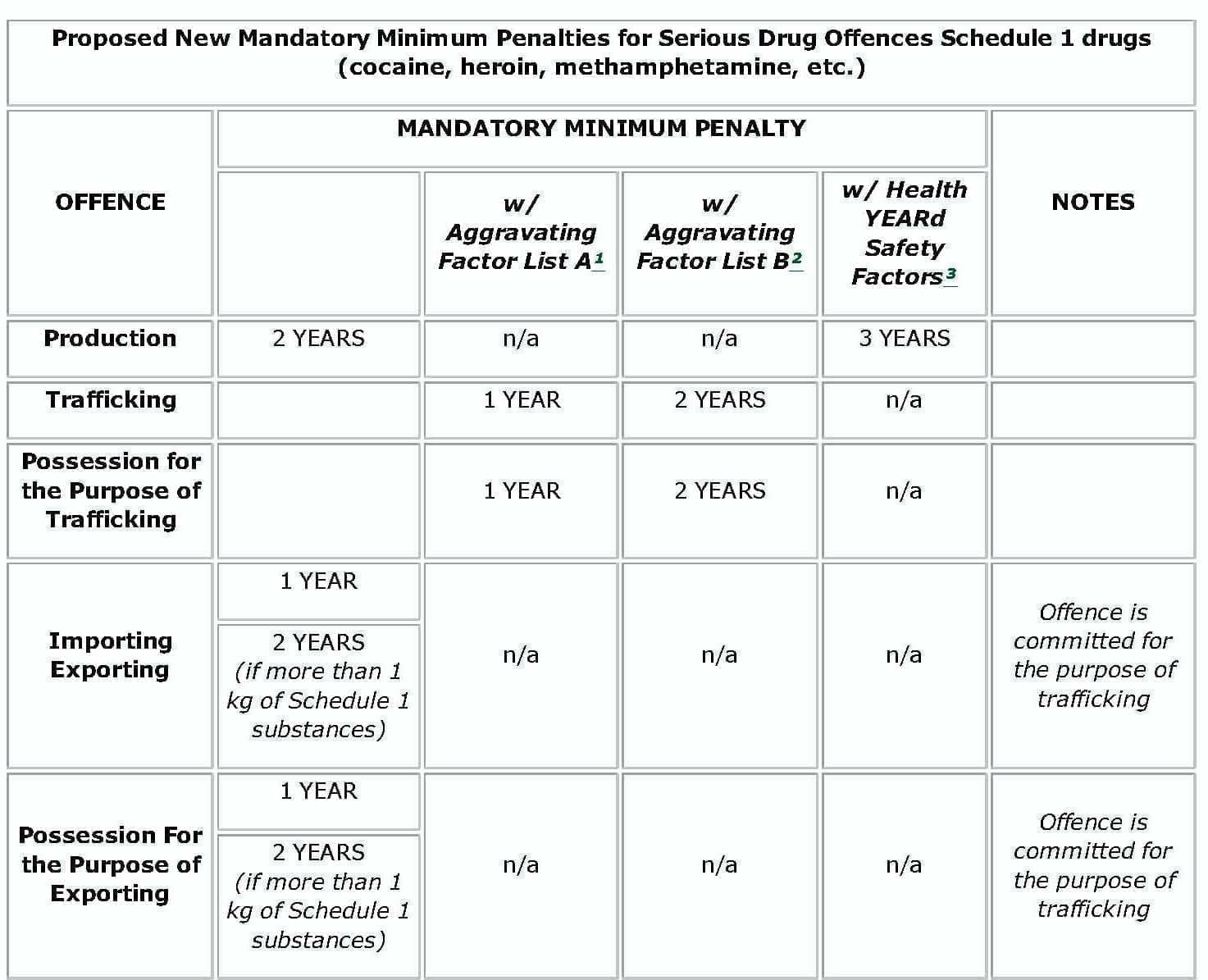
Serious drug offences include production; trafficking; possession for the purpose of trafficking; importing and exporting; and possession for the purpose of exporting drugs listed in Schedule I, such as heroin, cocaine and methamphetamine. Cannabis was then listed in Schedule II; it was removed from the CDSA altogether when the Cannabis Act came into force in October 2018.
Under that scheme, a mandatory minimum applied where an aggravating factor was present, including any of the following circumstances:
- for the benefit of organized crime;
- involving use or threat of violence;
- involving use or threat of use of weapons;
- by someone who has been previously convicted (in the past 10 years) of a serious drug offence;
- in a prison;
- by abusing a position of authority or access to restricted areas;
- in or near a school, in or near an area normally frequented by youth or in the presence of youth;
- through involving a youth in the commission of the offence; and
- in relation to a youth (e.g. selling to a youth).
Some offences, such as producing or importing a Schedule I substance, carried a minimum whether or not an aggravating factor was present, and cultivating more than five cannabis plants did the same. None of those minimums survives: Bill C-5 removed every one of them in November 2022.
Mandatory minimums for drug offences no longer exist in Canada; everything below is a historical record of the repealed scheme.
The two charts below are retained as a historical record of how the 2012 scheme was structured. They do not state the law as it stands today.
APPENDIX A
APPENDIX B
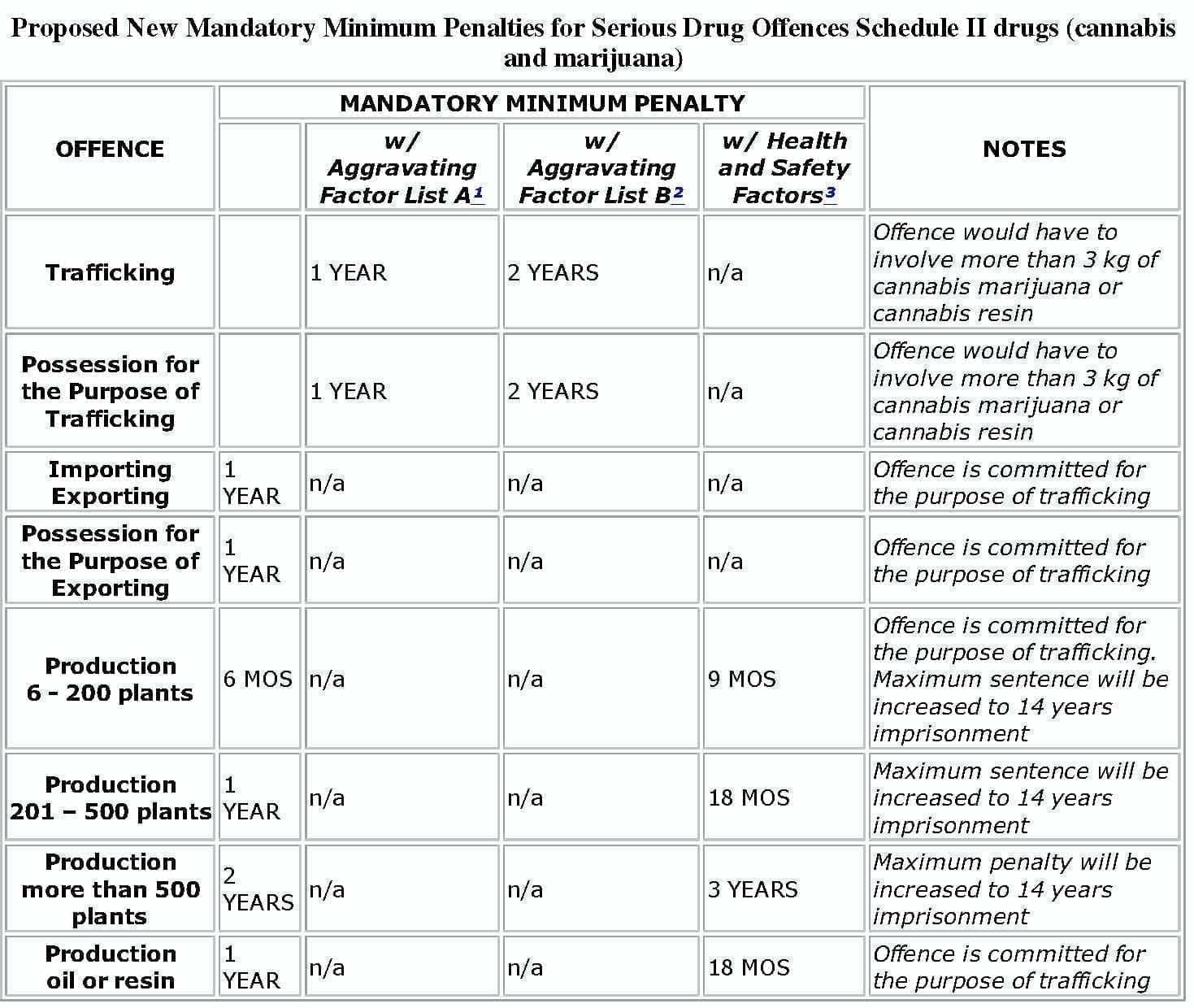
¹ Aggravating Factors APPENDIX A
The aggravating factors were offences committed:
- for the benefit of organized crime;
- involving use or threat of violence;
- involved use or threat of use of weapons;
- by someone who was previously convicted of a designated drug offence or had served a term of imprisonment for a designated substance offence in the previous 10 years; and,
- through the abuse of authority or position or by abusing access to restricted area to commit the offence of importation/exportation and possession to export.
² Aggravating Factors APPENDIX B
The aggravating factors were offences committed:
- in a prison;
- in or near a school, in or near an area normally frequented by youth or in the presence of youth;
- in concert with a youth; and
- in relation to a youth (e.g. selling to a youth).
³ Health and Safety Factors
- the accused used real property that belongs to a third-party to commit the offence;
- the production constituted a potential security, health or safety hazard to children who were in the location where the offence was committed or in the immediate area;
- the production constituted a potential public safety hazard in a residential area; and
- the accused placed or set a trap.
Why Choose Daniel Brown Law?
Daniel Brown Law is a leading Canadian criminal defence firm. Daniel Brown is a certified specialist in criminal law — a designation held by fewer than 2% of criminal lawyers in Ontario. He is the author of Prosecuting and Defending Sexual Offence Cases (3rd Edition, Emond Publishing’s Criminal Law Series), has authored articles for legal journals, and contributes commentary on criminal law to The Toronto Star and other major Canadian news outlets.
The firm and its lawyers have been repeatedly recognized for excellence in criminal defence:






So what Happens if its less then 5 like only two???
ive got seven years for importing 2.6 kg of cocaine can someone explaine to me why the heck i got so many years when the minimum sentence of my crime is only 2
so…..someone i know got busted holding (possession of 6 mdma) pills – personal; 148 grams of pot, possession for the purpose of trafficking. She waived lawyer at time and admitted pills were for her use (not a planned purchase…by chance, in case for later kinda thing). Doesn’t matter the why…she had em. (She doesn’t do them now). The pot she admitted to selling, so that she could get what she “needed” for cheap or free…not to get rich off of. She has bad anxiety and HEP C but can’t seem to acquire a medical card for the pot….so we put it off thinking might be easier to get when she started treatment for the HEP C. This is her FIRST OFFENCE. She is a recovering (very bad opiate iv user addict). Got clean in August 2012, busted for the pot in February. She is still opiate free. I think the police thinks she is a bigger fish in our town than she is. As they searched her vehicle and brought her in a second time in like under two weeks of being busted. FOUND NOTHING. Trust me, she has learned her lesson. She now works, has one subject left in community college to complete her course. Takes on-line courses in spare time for real estate. blah blah blah (i know too much info lol). Anyway, we are paying a lawyer that won’t even tell us what he charges, just keep cheques coming. Her plea of guilty he is giving tomorrow and hopefully holding sentencing off till fall. For all the money we are paying he doesn’t seem optomistic he can get her a good deal on the sentencing. I am confused being first time dealing with this, kinda wanted a second opinion i guess.